Product
APEC Vox QCA
AI-powered quantitative coronary angiography designed to deliver rapid, reproducible and auditable coronary measurements directly on a standard hospital computer.
From angiographic image to vessel segmentation, minimum lumen diameter and percentage stenosis in seconds, without cloud processing or specialist hardware.
Research and validation platform. Not a certified medical device; not for clinical use. Intended use
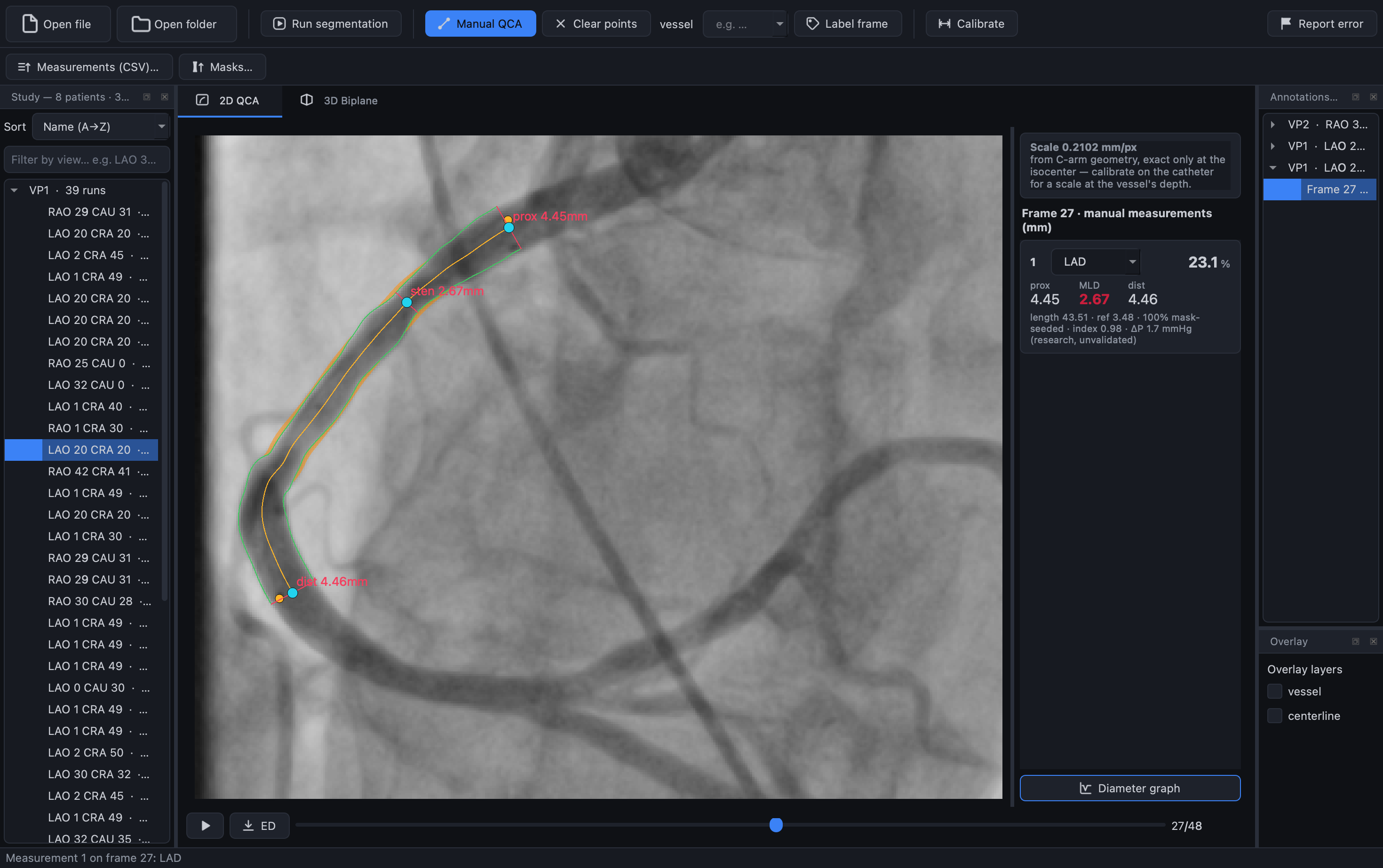
Measure
Measurement in seconds.
-
Standard angiographic inputs
DICOM cine, patient CD exports or single images. The end-diastolic frame is selected automatically.
-
Two-point interaction
The operator marks the start and end of the segment. Proximal, minimum and distal diameter and %stenosis are reported — in millimetres when the image is calibrated.
-
Seconds, on a standard computer
A standard laptop or PC, with no GPU, no cloud processing and no upload: images stay on the local machine.
- Windows 10/11
- macOS, Apple Silicon
- No GPU
- ~2 GB
- Offline after first launch
Why APEC Vox QCA?
Conventional QCA and APEC Vox QCA.
| Aspect | Conventional QCA | APEC Vox QCA |
|---|---|---|
| Workflow | Manual or semi-automated | AI-assisted |
| Interaction | Multiple manual adjustments | Two-point interaction |
| Platform | Specialist workstation | Standard laptop or PC |
| Hardware | May require dedicated hardware | CPU-based processing |
| Consistency | Variable workflow | Reproducible measurement pipeline |
| Adoption | Often underused clinically | Designed for rapid integration |
| Data | Potential external processing | Local, offline processing |
Conventional QCA: the semi-automated analysis packages supplied with cath-lab systems and core-lab workstations. APEC Vox QCA is currently a research and validation platform.
In development
Next-generation vessel reconstruction.
We are developing angiography-derived cross-sectional visualisation and lumen reconstruction for additional assessment of vessel geometry. The work is being validated against reference standards — intravascular ultrasound (IVUS) and commercial 3D-QCA — and is not part of the version made available for evaluation.
- Biplane 3-D reconstruction. Two angiographic views a few dozen degrees apart, and the vessel segment is reconstructed in three dimensions — its true length, without single-projection foreshortening.
- Lumen geometry. Minimum lumen diameter and area along the reconstructed segment, eccentricity, and the vessel coloured by lumen area.
- Cross-sectional visualisation. The shape and area of the lumen along the measured segment, derived from the angiogram.
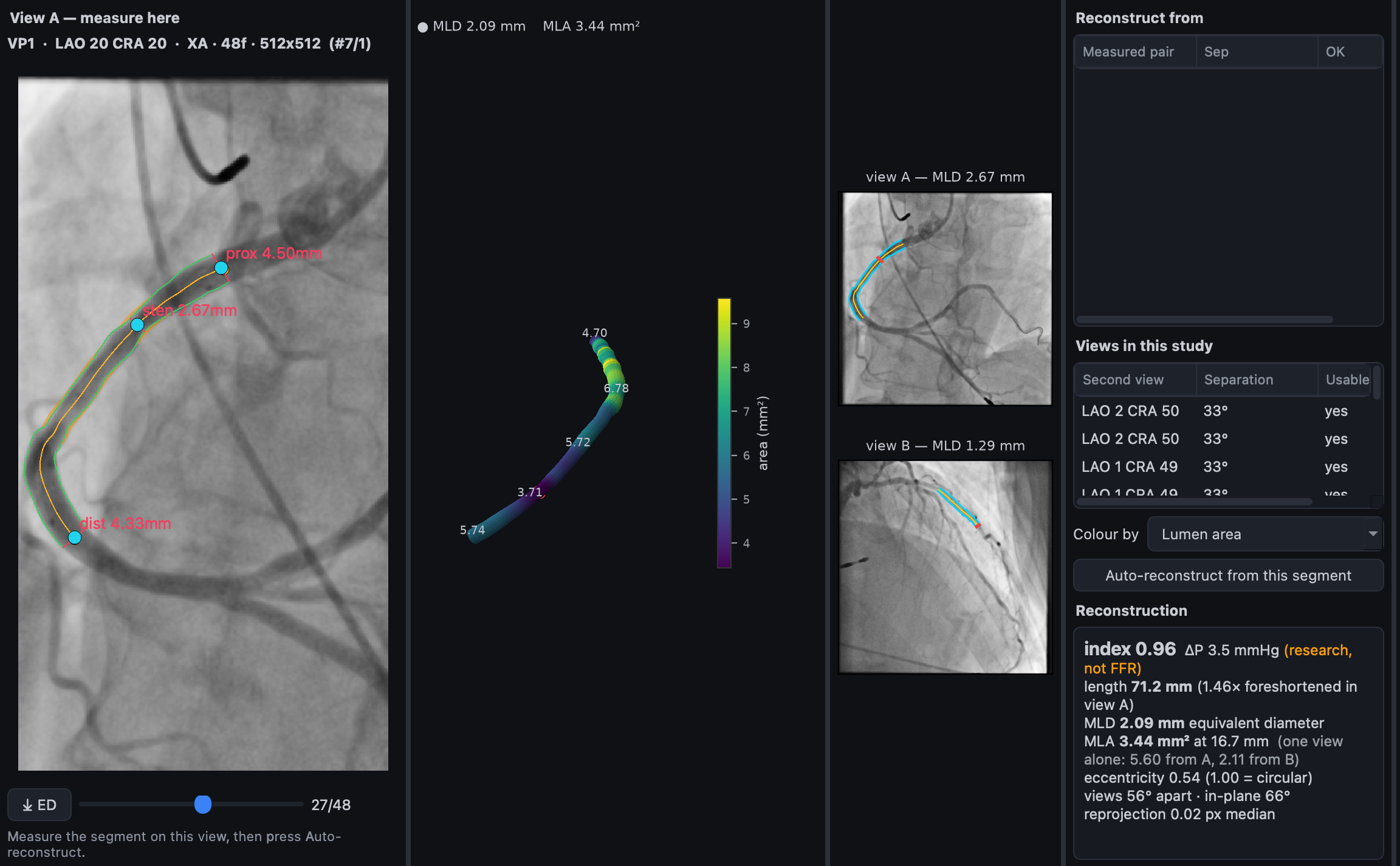
Reconstruction from angiography is not intravascular imaging and does not replace it. These views are research outputs; none of them is validated.
Status
Today, and what it is intended to become.
Research and validation platform
APEC Vox QCA is currently a research and validation platform, used under a research-use agreement. It is not a certified medical device, it has no diagnostic function, and its output must not be relied on in the care of a patient.
A clinical QCA tool
APEC is developing APEC Vox QCA towards a clinical quantitative coronary angiography tool. It will be offered for clinical use only once its validation is complete and the required regulatory approval is in place.
How to get it
APEC Vox QCA is made available to pilot sites under a research-use agreement. It is not on sale.